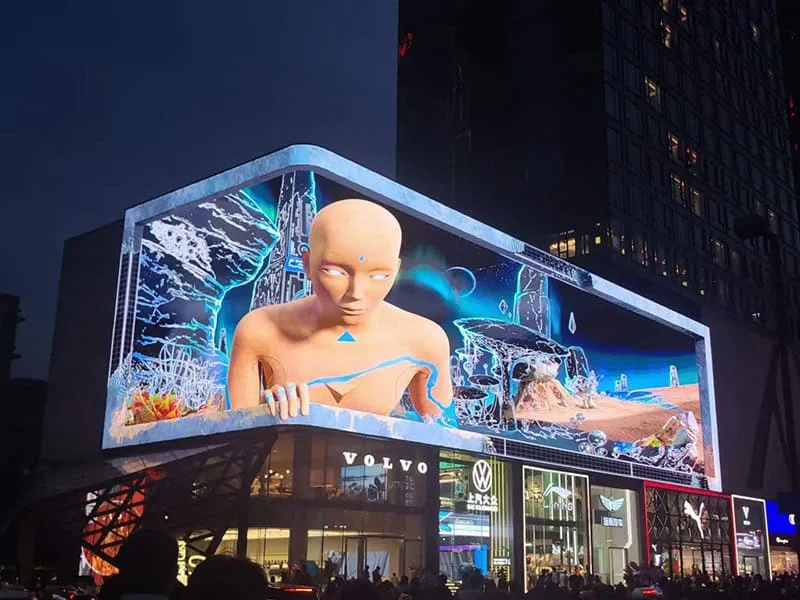
This guide explores the principles, hardware, and content creation process behind these 3d billboard displays. It also covers cost structures, success stories, pitfalls, and future innovations. Whether you are a brand, marketer, or LED enthusiast, this complete guide will help you understand how to make your 3D ad shine.
Part 1: Why Naked-Eye 3D Billboards Are the Future
1.1 What Is a Naked-Eye 3D Billboard?
A naked-eye naked-eye 3D billboard is more than a screen. It is a form of spatial illusion art. Instead of flat 2D video, it shows visuals that appear to pop out into real space. The big difference from traditional LED billboards is the jump from flat presentation to lifelike depth.
1.2 Why Are Naked-Eye 3D Billboards So Captivating?
- Visual Impact: They create immersive experiences that feel real.
- Viral Power: Their optical illusion content spreads fast on social media.
- Business Value: Brands gain higher exposure and stronger ad conversion rates.
👉 Watch the video 3 famous 3D billboard project in the world
Part 2: The Core Technology – Why Your Eyes Get Tricked
2.1 The Physics of Naked-Eye 3D
- Parallax Magic: Each eye sees a slightly different image. This difference creates depth.
- Single Viewpoint: The illusion looks best from a specific spot.
- Viewing Angle: Correct angle ensures realistic perception.
- Anamorphic Design: Images are distorted on purpose to appear correct from one viewpoint.
- Forced Perspective and Corner Screens: These structures amplify 3D effects by bending perception.
2.2 Hardware and Structure – Beyond the Screen
- LED Splicing: Screens can be flat, curved, shaped, or corner-based. Each type affects 3D results.
- Key Parameters: Pixel pitch, brightness, and refresh rate matter for clarity.
- Control Systems: Synchronization across multiple panels ensures smooth playback.
2.3 Content Creation – From 2D to 3D
- Anti-Distortion: Deliberate deformation of images ensures 3D looks right from the target angle.
- Rendering: Dual-screen rendering techniques polish the illusion and make it smooth.
2.4 Comparison with Traditional LED Screens
| Factor | Naked-Eye 3D Billboard | Traditional LED Billboard |
|---|---|---|
| Visual Effect | Immersive, lifelike | Flat, 2D |
| Hardware Needs | Advanced, corner setup | Standard flat screen |
| Content Creation | Complex 3D rendering | Simple video |
| Cost | High | Lower |
| Impact | Viral potential | Limited reach |
Part 3: Step-by-Step SOP for Creating 3D Content
3.1 Creative Thinking
- Breaking the Frame: Design objects that appear to jump out.
- Depth and Layers: Use perspective, lighting, and shadows to create depth.
3.2 Production SOP
- Concept & Storyboard: Plan key frames and sketch ideas.
- Modeling & Animation: Build 3D models, apply textures, and animate.
- Anti-Distortion & Rendering: Adjust content for the exact screen layout.
- Post-Production: Final color correction and export.
3.3 Recommended Software Tools
- Blender: Free 3D modeling and animation.
- Cinema 4D: Professional tool for motion graphics.
After Effects: Ideal for compositing and visual polish.
👉 *Tip: To get some ideas on 3d content creation,you can watch this video: Create 3D BILLBOARD VIDEOS for Curved Screens


Part 4: Real-World Practice – Cost Breakdown and Pitfalls
4.1 Cost Structure of Naked-Eye 3D Billboards
- Hardware Costs: The screen, steel frame, control systems, and installation.
- Content Costs: Creative design, 3D modeling, animation, and rendering.
- Maintenance Costs: Power, LED module replacement, calibration, and cleaning.
4.2 Successful Case Studies
Success Stories:
- The “Waves” project in Seoul amazed millions worldwide.
- The Chengdu “Spaceship” ad went viral with its UFO illusion.
3D Ads Solution
Here you can check the 3D ads billboard solution. hope it bring you ideas on project design.
Part 5: Pros, Cons, and Comparison with Traditional Screens
Advantages
- Stunning optical illusion
Naked-eye 3D billboards create a powerful sense of depth and realism. For example, a 3D car ad can look like it’s driving out of the screen, instantly grabbing attention. - Interactive and immersive
Audiences often stop to take photos or videos, which extends the reach of the campaign. A 3D animal jumping out of a corner screen can make people feel part of the scene. - Viral marketing potential
Striking visuals are highly shareable on social media. Many 3D ads in New York or Dubai have gone viral, generating millions of views without extra ad spend. - High brand recall
Because the experience is so memorable, people are more likely to remember the brand. For instance, a luxury watch presented in 3D makes a lasting impression compared to a flat 2D display.
Disadvantages
- High investment cost
From LED hardware to 3D content production, the upfront budget is significant. A large-scale corner billboard can cost several hundred thousand dollars. - Technical barriers in production
3D content requires expertise in perspective, rendering, and anti-distortion techniques. Small mistakes can make the illusion look flat or awkward. - Viewing angle dependency
The 3D effect works best from specific positions. If viewers stand outside the target angle, the content may appear distorted or lose depth. - Complex maintenance
Outdoor 3D billboards face challenges like weather, dust, and high power consumption. For example, replacing faulty LED modules on a massive curved screen is both costly and time-consuming.
Comparison Chart
| Factor | Naked-Eye 3D Billboard | Traditional LED Billboard |
|---|---|---|
| Attention Level | Very high | Moderate |
| Content Type | Anamorphic 3D | Flat 2D |
| Social Media Value | High viral chance | Limited |
| Cost | Expensive | Lower |
| Maintenance | Complex | Easier |
Part 6: Future Trends and Innovations
3D billboards are no longer limited to optical illusions — they’re moving toward a future where technology, creativity, and audience engagement blend seamlessly. Here are some key directions shaping the industry:
- AI + Real-Time Rendering
Artificial intelligence will make 3D ads smarter and more dynamic. Instead of showing the same animation all day, billboards can adjust based on traffic flow, time of day, or even audience demographics. Imagine a sports brand displaying sneakers during the morning commute and switching to gym wear in the evening. Real-time rendering powered by AI ensures smooth transitions without heavy manual work. - XR, AR, and Mixed Reality
Extended Reality (XR) and Augmented Reality (AR) will transform billboards into interactive playgrounds. A passerby could point a smartphone at a 3D car ad and instantly see the car’s interior in AR, or weather conditions could trigger content changes — like sunscreen ads appearing only on sunny days. This fusion of physical and digital spaces deepens engagement while keeping content fresh and relevant. - Green Tech and Sustainable Displays
As cities push for eco-friendly advertising, 3D billboards are adopting green technologies. Next-gen LED panels will integrate solar power and energy-efficient drivers, while nano-coatings could keep screens self-cleaning and bright with minimal maintenance. By reducing power consumption and extending hardware life, brands not only cut costs but also align with global sustainability goals. - Hyper-Realistic Holograms
The next step beyond naked-eye 3D is holography. Floating 3D projections will make products appear life-sized in mid-air, eliminating the need for special glasses. Companies like Samsung and Sony are already testing holographic billboards that turn science fiction into reality. - Interactive Gaming Experiences
Future campaigns may gamify outdoor advertising. Using motion tracking, passersby could control on-screen animations just by moving their hands or phones. For example, a beverage ad might invite viewers to “catch” virtual bottles for discounts, turning attention into participation.

- Metaverse Bridges
Physical billboards will connect seamlessly with digital platforms. QR codes or AR triggers could transport viewers into virtual brand worlds, where a 15-second street ad evolves into a full augmented reality showroom. This bridge between outdoor media and the metaverse will extend campaign reach far beyond a single location.
👉 Tip: Insert a video demo of AI-driven 3D billboards here.

Part 7: Conclusion
Naked-eye 3D billboards are more than screens. They are storytelling platforms that mix art, science, and marketing. From corner screen structures to anti-distortion rendering, every detail shapes the audience experience.
Brands that invest in this technology gain powerful exposure and viral moments. To succeed, work with experts who provide full solutions. Companies like Ledtoptech deliver one-stop services, from LED screen production to 3D content creation.
With the right approach, your ad can become the next global 3D sensation.

